Bilateral paracentral acute middle maculopathy (PAMM)
This 29-year-old gentleman presented to his optometrist with central blurring affecting both eyes. Best corrected visual acuity was 6/7.5 bilaterally.
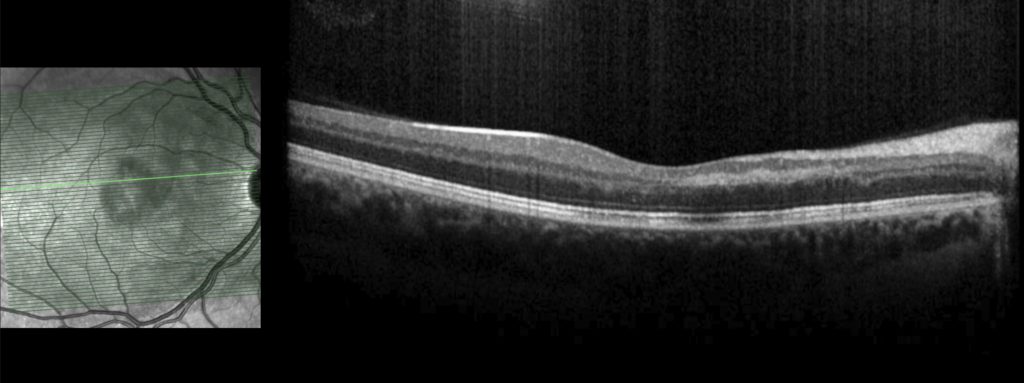
Macular OCT – right eye
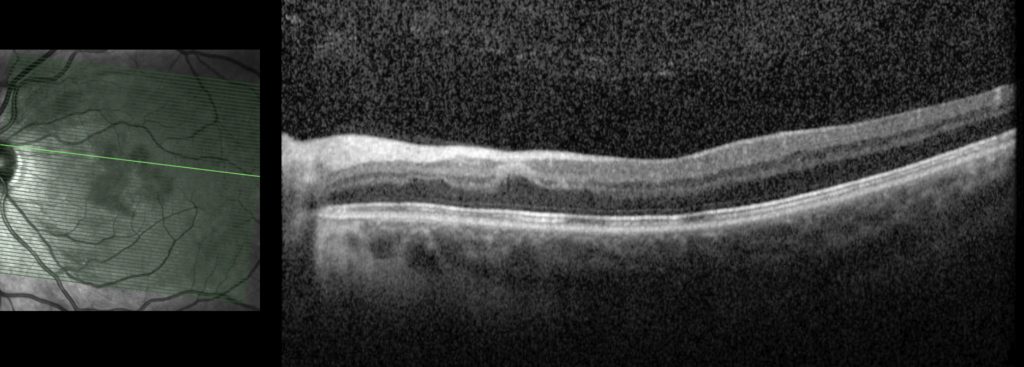
Macular OCT – left eye
Macular OCT revealed bilateral hyperreflective bands within the parafoveal inner nuclear layer, corresponding to the hyporeflective areas seen on near infra-red imaging.
These changes are typical of paracentral acute middle maculopathy (PAMM) . PAMM is characterised by hyperreflective band-like, multiple or isolated focal or diffuse lesions visible at the level of the inner nuclear layer (INL) in patients presenting with acute onset negative scotoma.
The aetiology of PAMM is uncertain, but it has been attributed to acute ischaemia of the intermediate and deep capillary plexuses, which may herald the presence of underlying secondary conditions like retinal vascular diseases. It has been reported following coronavirus infection . However, PAMM may also be idiopathic and can develop in younger and otherwise healthy individuals with a normal systemic history.
The main differential diagnosis is Acute Macular Neuroretinopathy (see the AMN case from 1st May 2022 ).
The prognosis is generally quite good. Full resolution of symptoms can occur, but subtotal resolution is perhaps more common.